

The shaft is a mechanical element used for the rotation or movement of a workpiece or a cutting tool. The spindle results in rotation, and the feed shaft results in displacement.
The most basic one is the three-axis machine tool. A three-axis machine tool has the X-axis, Y-axis, and Z-axis, enabling movement in six directions: front and rear, left and right, and up and down.
In the past few years, CNC machining technology has evolved from simple machine tools to sophisticated ones. To meet the need for machining intricate shapes, multi-axis machine tools have evolved quickly. 5-axis CNC machining is one of the most sophisticated machining techniques available today. It employs subtractive machining technology, providing unlimited possibilities for the manufacture of parts. It uses five-axis cutting tools to shape and size the workpiece by cutting it as needed. Five-axis machine tool complements the B-axis and C-axis according to the three axes, which enables more complex machining.
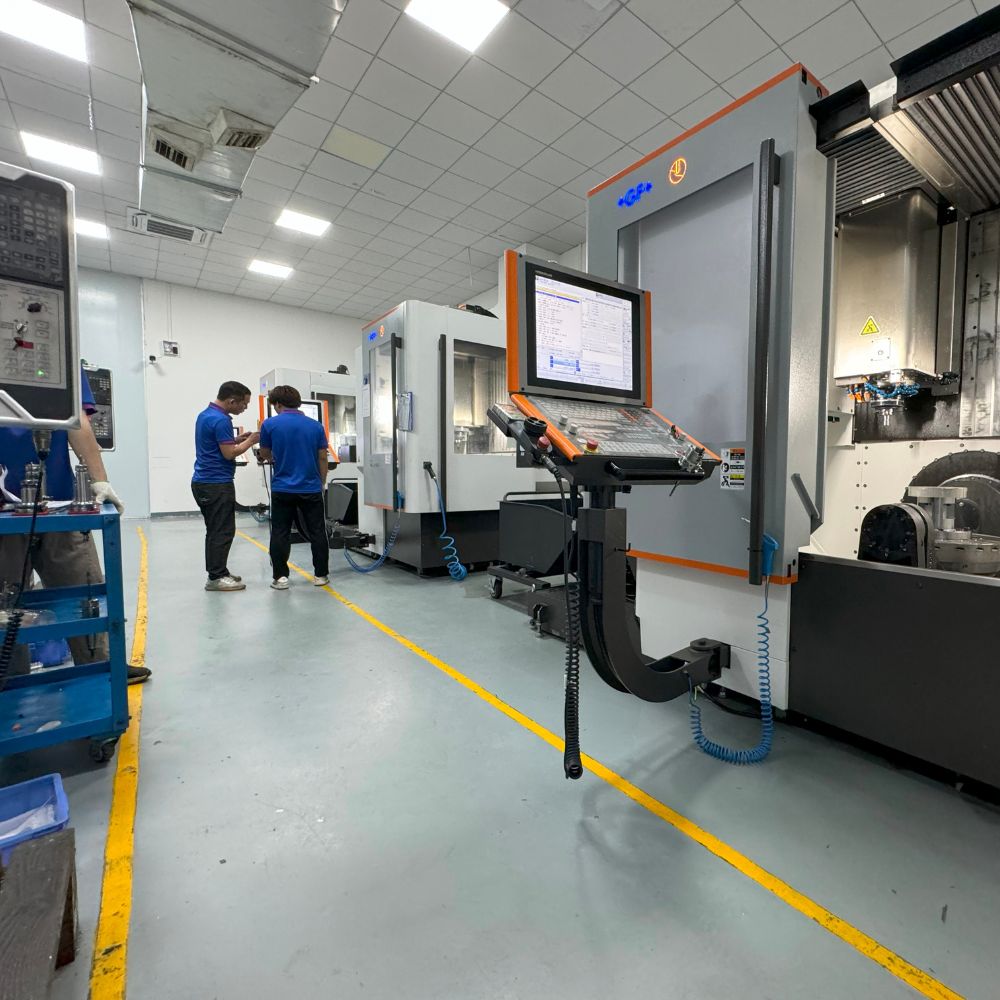
What is 5-axis machining?
The five-axis machining technology is the most advanced machining machine tool of the numerical control machine tool technology and has a number of advantages. In 5-axis machining, X, Y, Z, B, and C axes are able to move collectively to machine, allowing for the manufacturing of complex shapes with high accuracy. 5-axis machining is better suited to be utilized in aerospace, automobile, and mold-making industries. Especially when the pieces with complex shapes such as body parts with free surfaces, turbine parts, and impellers should be machined, it demonstrates its important benefits.
Machining Advantages
- Reduce the frequency of clamping operations: With the addition of rotational and tilting movements, 5-axis machining can keep a consistent machining process without frequent changes in the machining surface, thus reducing the reinstallation of workpiece, tool, and fixtures.
- Improve machining accuracy and quality: With a declining installation change frequency, 5-axis machining reduces the possibility of deviation in precision and fluctuations in quality with respect to installation changes, ensuring consistent machining accuracy and quality.
- Improve the efficiency of tool usage and fixtures: 5-axis machining allows some components that would otherwise have required long or dedicated tools to be machined with standard tools, minimizing the amount of tools and fixtures used. It also decreases tool protrusion and enhances stability in machining.
Advantages of Five-Axis Machining
As for advantages of five-axis machining, of course, it has the B and C axes that are freely rotatable in machining compared to three-axis machining, there are fewer clamping operations and the machining time is shorter.
Maintain the best cutting state of the tool and improve the cutting conditions
When the cutting tool moves to the tip or the edge of the workpiece in the three-axis cutting mode, the cutting state will gradually deteriorate. For maintaining the best cutting state at the tip or the edge of the workpiece, the worktable has to be rotated and the workpiece re-clamped. And if we want to machine an irregular plane completely, we must turn over the worktable a few times with different orientations. From the above description, we can find that the additional B and C axes of the five-axis machine tool can avoid the situation that the linear speed at the center point of the ball-end milling cutter is 0, and achieve a better surface quality.
Effectively avoid tool interference
Compared with three-axis machining, three-axis machines can not meet the process requirements due to interference reasons. However, a five-axis machine tool can. In the meantime, a five-axis machine tool can use shorter tools for machining, enhancing the system rigidity, reducing the number of tools, and eliminating special tools. For our company executives, it means that as for tool costs, a five-axis machine tool will be more cost-saving!
Reduce the number of clamping operations and complete the machining of five surfaces in one clamping
As it can be seen from the following figure, a five-axis machining center can also decrease the reference conversion and enhance the machining accuracy. In practical machining, only one clamping is needed, and it’s easier to be ensured of the machining accuracy. In the meantime, since the chain of processes is shortened and the number of equipment is reduced, the number of tooling fixtures, the area of workshop floors, and the cost of equipment maintenance are also reduced. What this implies is that you are able to achieve more efficient and better-quality machining with fewer fixtures, less workshop floor area, and lower maintenance costs.
Shorten the production process chain and simplify production management
The complete processing of a five-axis numerical control machine tool can greatly shorten the production process chain, which can make production management and planning scheduling easier. The more complex the workpiece is, the stronger its advantage is over the scattered process traditional method.
Shorten the product research and development cycle
For businesses in such industries as aerospace and automobile, some of the new product elements and molds for molding are with complex shapes and high accuracy. Therefore, a five-axis numerical control machining center with high flexibility, high precision, high integration, and full-machining functions can solve the problem of the accuracy and cycle of machining complex components in new product research and development more effectively, greatly shortening the research and development cycle and improving the success rate of new products.
Disadvantages of Five-Axis Machining
- High cost: Since there are more specialized numerical control systems for 5-axis machining, their cost has also risen proportionally.
- Increased programming and control: In cutting intricate shapes and performing continuous cutting, the programming and control work of 5-axis machining becomes more challenging and complex.
- More operator demanding: 5-axis machining requires advanced programming, machine tool setup, and operation. Therefore, very skilled technical operators are required. This typically means more labor cost.
- Risk of material waste: Since a five-axis machine tool can perform very complex cutting operations, operators can cause material waste, especially when they are cutting expensive materials.
Conclusion
Although five-axis machining has many advantages, there are also some disadvantages. For example, it requires higher technical requirements for operators. Therefore, in making a decision in favor of five-axis machining, one should make a choice according to some machining requirements and processing capabilities. For complex parts, five-axis machining will be an extremely good choice.
Five-Axis Machining Services
As mentioned above, a five-axis machine tool has so many advantages. But the tool attitude control, the numerical control system, CAM programming, and the post-processing of a five-axis machine tool are much more sophisticated than those of a three-axis machine tool! But our KESU firm has hired an elite team of highly professional and experienced technical minds. They know different CNC machining processes. They are able to ensure quality in production from precision machining of intricate parts to large production projects.


